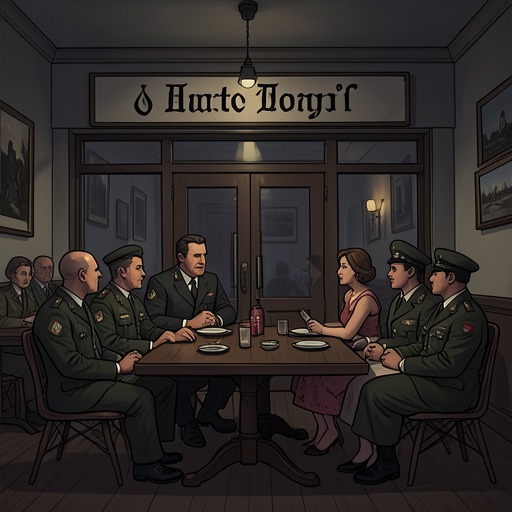
Always resent, never relent
The SympathizerAlways resent, never relent is a motto proposed by The General as he plans an underground counteroffensive from exile. Its compact rhythm makes resentment sound not merely like an emotion but like a continuing political obligation: the war must remain present in memory, and resistance must not give way to fatigue.
Coined as a political motto
The phrase emerges during a discussion of how to rebuild a fighting force. A return by sea is judged too difficult, so the plan is to go overland; Claude is seeking money, and the prospective force will need recruits, weapons, training, a training site, and transport to Thailand. The General insists that the work must be planned over decades and conducted underground, as the communists had done. The unnamed narrator observes that they are already acquainted with darkness. The General answers that they have never really had a choice: history has moved them, and they must keep fighting both evil and the danger of being forgotten. He picks up Sonny's Newspaper to make the point that even speaking of the war as over could encourage complacency. In that setting, the proposed motto gives a memorable verbal shape to a strategy of endurance.
The newspaper and the culture front
The unnamed narrator adds that the people must not be allowed to forget their resentment, and that newspapers can contribute on the culture front. The General agrees, but makes the work conditional on journalists doing their jobs properly. He tosses the newspaper back onto the table, calls resentment a good word, and proposes Always resent, never relent as a motto. The exchange connects military planning to the contest over public memory: the campaign depends not only on men, arms, and transport, but also on shaping what people remember and feel. The wording is forceful because its two halves reinforce and sharpen one another. Resentment is made lasting; relent is what the motto forbids. Yet the phrase is proposed rather than shown being formally adopted or widely circulated. Its immediate significance lies in the General’s effort to turn an emotion into a principle for the movement and a message for its supporters.
Resentment, representation, and the cost of memory
The book places this proposed cultural strategy beside competing representations of the war. In the film being made for Hollywood, Vietnamese refugees perform Viet Cong torturers, including a staged water-torture scene. Elsewhere, the unnamed narrator remembers an actual interrogation room where a Communist agent was sexually assaulted by police while he watched. The contrast makes the culture front more than a question of publicity: war stories can shape whom an audience is taught to hate, while the violence they depict may be fictionalized, displaced, or concealed. Near the end, amid the unnamed narrator’s fragmented recollection and plea for the interrogation to stop, resentment returns in a counterfactual: “if we forgot our resentment, if we forgot revenge”. The passage does not simply repeat the General’s proposed motto; it exposes the burden contained in it. Remembering can sustain resistance against erasure, but a demand to preserve resentment also binds political purpose to revenge and to the violence that memory carries forward.